Use these conclusions to decide whether 4140 is the right alloy for your high-strength actuator rod application.
Hybrid tool + sourcing guide
Use 4140 for high-stress and high-pressure applications.
4140 is a better fit than 1045 when shock loading, reversing fatigue, or pressure cycles make core toughness and hardenability part of the risk calculation.
Evidence basis: 4140 chemistry, fatigue/toughness notes, and MTR-dependent heat condition
Pre-hardened 4140 (28-32 HRC) balances strength and distortion risk.
Starting with pre-hardened material avoids the severe distortion that occurs if a finished rod is through-hardened. The surface can still be induction hardened to 50-60 HRC.
Evidence basis: Standard heat treat sequencing for precision shafts
Cutting data must be reset for the supplied heat condition.
Do not quote annealed, Q&T, and induction-hardened 4140 with the same speed/feed assumptions. Hardness and heat history drive insert grade, coolant strategy, and cycle time.
Evidence basis: Sandvik Coromant workpiece-material guidance and insert-specific ToolGuide checks
Rigidity dictates the tolerance limit on high L/D rods.
The toughness of 4140 demands higher cutting forces. Rods with L/D ratios > 10 require steady rests, and L/D > 30 often requires centerless grinding from oversize bar.
Evidence basis: Deflection physics and machining best practices
Hard chrome plating requires hydrogen embrittlement baking.
High-strength 4140 (above 31 HRC) is highly susceptible to hydrogen embrittlement during electrolytic plating. Failing to specify a post-plating bake-out will lead to catastrophic brittle failure under load.
Send diameter, length, material condition, hardness, finish, plating notes, and certificate requirements so the RFQ review can separate routine turning from grinding, heat-treatment, or inspection risk.
4140 provides superior toughness and fatigue life over 1045. It is the standard for high-performance hydraulic cylinders, aerospace actuators, and heavy industrial equipment.
Machinability Challenges
Alloying elements (Cr, Mo) increase toughness but lower machinability. Annealed, Q&T, and locally hardened bars should not share one speed/feed assumption; the selected insert, hardness, coolant, and setup rigidity must be confirmed before quote lock.
Heat Treatment Options
Highly responsive to localized heat treatment. Quenched & Tempered (Q&T) standardizes core toughness (typically 28-32 HRC when specified by the supplier or drawing), while induction hardening can create a high-hardness case for seal wear zones without through-hardening the full rod after finish machining.
Fatigue & Yield Strength
Q&T 4140 is often selected when core strength, shock resistance, and fatigue margin matter more than lowest material cost. Final yield and tensile acceptance should come from the MTR and heat-treatment certificate, not a generic grade name.
What must be confirmed before production
2D drawing with revision level and dimensions before/after plating
3D model if shoulders, flats, cross holes, or end features are complex
Material condition: Annealed or Q&T (specify required HRC range)
Critical tolerance stack: diameter, straightness, runout, thread, seal land
Surface finish and inspection method for each sliding or sealing zone
Plating type (e.g., Hard Chrome) and coating thickness if required
Prototype quantity, annual volume, packaging, and required certificates
Machining Induced Stress: Heavy turning on 4140 can introduce residual stresses. Stress relieving or starting with normalized/Q&T bar helps maintain straightness during subsequent operations.
Distortion in Heat Treat: If full through-hardening is done after roughing, distortion is likely. We prefer starting with pre-hardened material for the core, then localized induction hardening for wear zones.
Deflection: Higher cutting forces require rigid setups. L/D > 10 necessitates tailstock or steady-rest support to prevent chatter.
Review Before Trusting the Output
Calculator misuse
Trigger: Browser result is treated as drawing approval or guaranteed lead time.
Mitigation: Use the output only as RFQ triage; release production after drawing, MTR, tolerance, and inspection review.
Cost underquote
Trigger: Q&T bar, tight Ra, plating allowance, or slender L/D ratio is missing from the RFQ.
Mitigation: Quote turning, straightening, grinding, coating, and post-finish inspection as separate process assumptions.
Scene mismatch
Trigger: 4140 is selected for corrosion-heavy service where strength is not the limiting failure mode.
Mitigation: Compare 17-4 PH, 316, coatings, or seal/bushing changes before locking the material.
Inspection gap
Trigger: Only nominal diameter is called out for a seal land or sliding zone.
Severe corrosion without coating or stainless requirement
High shock, high-cycle fatigue, or deep hardenability need
Lowest-cost standard-duty rods with benign corrosion risk
Strength ranges are selection context, not acceptance criteria. Production acceptance should reference drawing notes, MTRs, hardness reports, and finish certificates.
Evidence, Limits, and Source Traceability
Last updated: June 29, 2026. External references are used for standard scope and material/tooling context; production acceptance still depends on drawing notes and supplier records.
Primary References:
ASTM A108-24: Current ASTM listing for cold-finished carbon and alloy steel bar scope, reviewed June 29, 2026.
AZoM AISI 4140 datasheet: Chemistry, annealed baseline properties, machinability, and heat-treatment context for AISI 4140.
ASTM B850: Standard guide for post-coating treatments of steel for reducing risk of hydrogen embrittlement.
Claim
Evidence basis
Source
Limit / verification
4140 material standard basis
ASTM A108-24 covers cold-finished carbon and alloy steel bars for heat treatment, machining into components, or as-finished shafting use.
ASTM A108-24 listing
Chemistry and condition must be MTR verified. The standard scope does not replace customer drawing acceptance criteria.
Cutting data sensitivity
Sandvik Coromant notes that alloying, heat treatment, hardness, and material group drive tool geometry, grade, and cutting data.
Sandvik Coromant workpiece materials
Exact m/min, feed, and depth of cut must be confirmed against the selected insert, machine rigidity, coolant, and bar hardness.
Superior strength vs 1045
Published AISI 4140 datasheets identify chromium-molybdenum chemistry, high fatigue strength, and baseline annealed mechanical properties; Q&T values are condition-specific.
AZoM AISI 4140 datasheet
Do not accept a generic web value for production. Require MTR, heat-treatment route, hardness range, and section-size context.
Precision tolerance capability
Actuator Machining internal production baseline for qualified ground hydraulic seal surfaces and finished rod inspection.
Internal process baseline
Feature length, L/D ratio deflection, datum structure, grinding allowance, and coating stack control the final viable tolerance.
Hydrogen embrittlement risk
ASTM B850 requires post-coating baking for high-strength steels (typically > 31 HRC or > 1000 MPa tensile) to relieve hydrogen absorbed during electroplating.
ASTM B850 standard
Bake-out must occur rapidly after plating (usually within 3-4 hours) at ~375°F (190°C). Plating vendor must provide a baking certificate.
Related Engineering Pages
Use these internal references to complete the material, drawing, inspection, and adjacent rod-design decisions behind a 4140 RFQ.
High risk of deflection. May require centerless grinding from oversized bar.
Welded eye actuator rod
D50 x L800 mm, welded rod end, moderate pressure
Evaluate material switch to 1045 or Friction Weld
Avoid 4140 if possible to reduce weld cracking risk, or redesign to a threaded two-piece assembly.
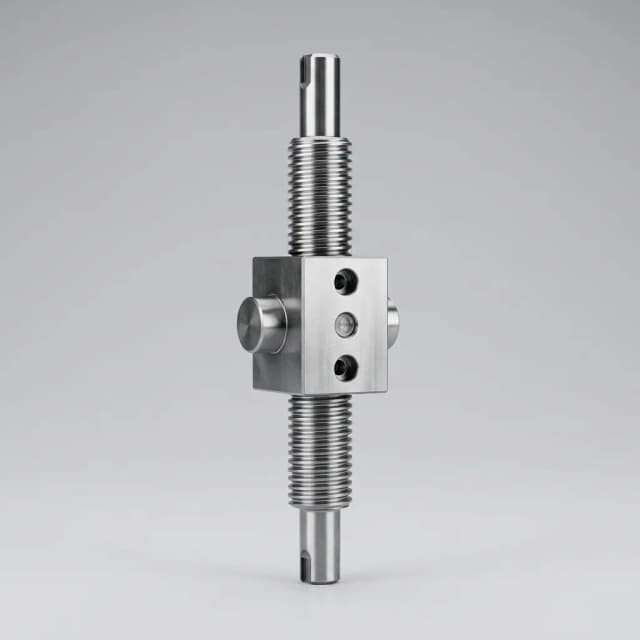
Representative shaft and rod machining visuals.
Representative Turned Rod Profile
Representative Grinding / Inspection Setup
Representative Finished Rod Features
Frequently Asked Questions
Why choose 4140 steel over 1045 for actuator rods?
4140 is a chromium-molybdenum alloy steel that provides superior yield strength, fatigue resistance, and through-hardenability compared to 1045. It is the preferred choice for high-pressure hydraulics, heavy shock loads, and demanding cyclical applications.
Is 4140 more difficult to machine than 1045?
Yes. Depending on its heat treatment condition (e.g., pre-hardened at 28-32 HRC), 4140 requires more rigid tooling, lower cutting speeds, and careful chip management compared to standard 1045, which increases cycle times.
What is the maximum Length-to-Diameter (L/D) ratio you can machine?
For 4140 actuator rods, L/D ratios up to 10:1 are standard. Ratios between 10:1 and 20:1 require steady-rest or tailstock support. Due to the high cutting forces required for 4140, deflection is a significant risk on slender rods, so rigid workholding is critical.
Do you offer heat treatment and surface plating for 4140?
Yes. 4140 can be quenched and tempered for core strength, and induction hardened on the surface for wear resistance. We also coordinate chrome plating, nickel plating, or black oxide finishes, grinding the rod to size before or after plating as specified.
When is 4140 not the right rod material?
If the application involves severe corrosive environments (like offshore marine), a stainless steel like 17-4 PH or 316 may be required. For very light-duty pneumatics, 4140 might be over-engineered, and 1045 or aluminum could reduce costs.
What drawing details reduce quoting uncertainty?
Call out rod diameter tolerance, straightness/runout datum, surface finish (Ra), pre-hardened vs annealed state, case hardness depth (if induction hardening), plating thickness, and whether dimensions apply before or after plating.
Can you quote without a 3D model?
A 2D drawing is sufficient if it fully defines dimensions, tolerances, and heat treatment requirements. A 3D model is helpful for complex end features, threaded holes, and milled flats.
How should heat treatment be sequenced for 4140?
For precision rods, we typically rough turn the material in the pre-hardened state, perform induction hardening on wear zones if required, straighten the rod, and then perform final centerless or cylindrical grinding.
What inspection records should be requested?
Request material test reports (MTRs) to confirm the 4140 chemistry and heat condition, dimensional reports for critical seal diameters, surface roughness (Ra) readings, and coating thickness checks.
Do the calculator results approve the drawing for production?
No. The calculator is a routing triage tool for early RFQ planning. Production release still needs drawing review, material condition confirmation, tolerance stack review, and inspection plan approval.
Are the strength values guaranteed for every 4140 bar?
No. 4140 strength depends on heat treatment, section size, supplier route, and the actual heat lot. Use published data as selection context, then require an MTR and heat-treatment certificate for acceptance.
How do plating dimensions affect the finished rod size?
Define whether critical diameters apply before or after plating. Hard chrome, nickel, or other coatings can require grinding allowance, masking notes, coating thickness checks, and final post-plate inspection.
Can I weld a clevis directly to a 4140 actuator rod?
Welding 4140 is difficult due to its high carbon equivalent and alloying elements. Without strict pre-heating (200°C-400°C) and post-weld stress relief, the heat-affected zone (HAZ) is highly prone to cracking. For welded rod ends, 1045 is often preferred unless the high strength of 4140 is absolutely required.
Does hard chrome plating affect 4140 rod strength?
It can cause hydrogen embrittlement. If the 4140 rod is hardened above ~31 HRC (or ~1000 MPa tensile), hydrogen absorbed during the plating process can cause sudden, brittle fractures. A post-plating bake-out (e.g., per ASTM B850 or AMS2759/9) is mandatory to drive out the hydrogen.