
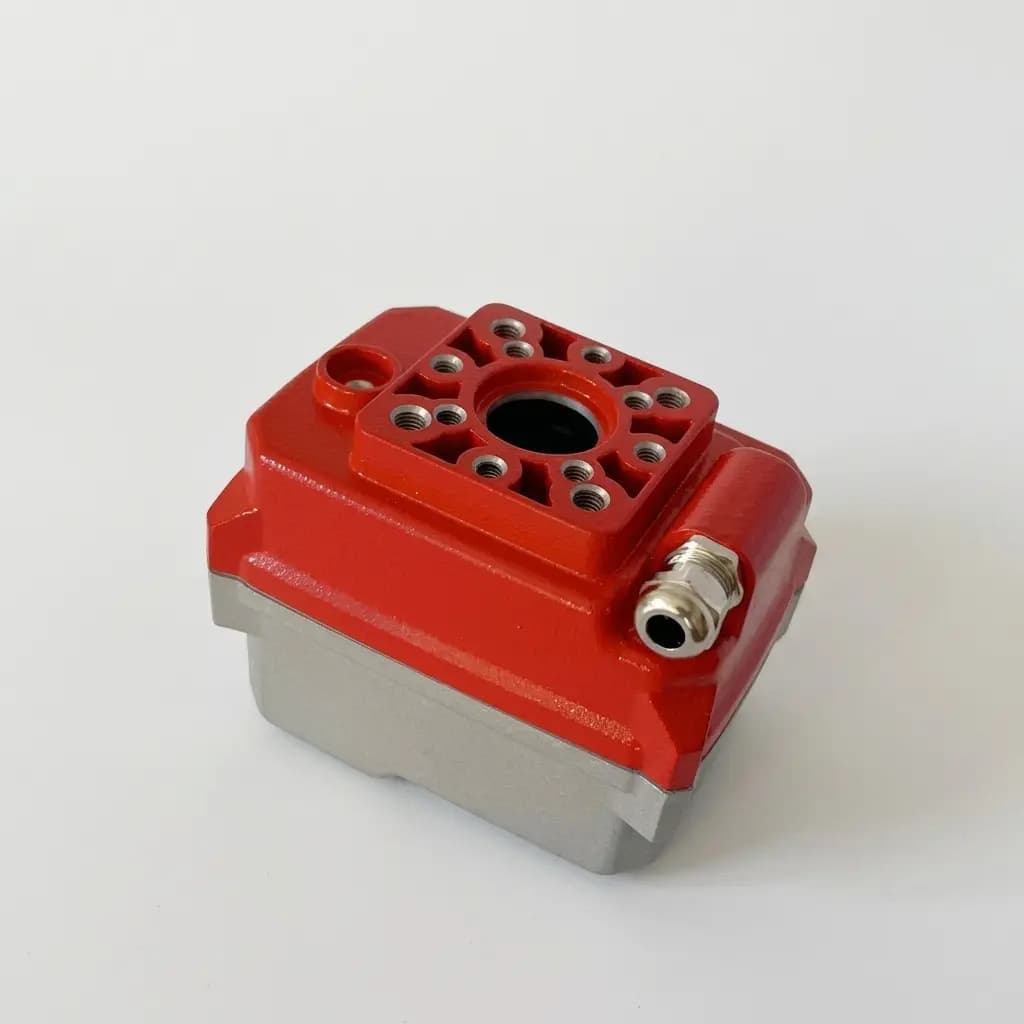
Thermal Dissipation in Actuator Housings: Fin Design, Material Selection, and Emissivity
How to design actuator housings for thermal management: aluminum alloy conductivity, CNC fin constraints, surface emissivity, and DFM rules.
High-torque servo motors and densely packed planetary gearboxes generate massive amounts of heat. In enclosed industrial environments—such as robotic welding cells or IP67-rated enclosures—that heat has nowhere to go.
If the internal temperature of an actuator exceeds 90°C, rare-earth motor magnets begin to demagnetize, grease breaks down, and thermal expansion destroys gear backlash tolerances. The actuator housing is the only passive cooling path you have.
1. Thermal Failure Cascade in Actuators
Understanding why heat kills actuators means following the failure chain:
2. Material Selection: Thermal Conductivity vs. Strength
The choice of aluminum alloy has a direct impact on how fast heat moves out of the housing.
| Alloy | Thermal Conductivity | Yield Strength | Density | Best Used For |
|---|---|---|---|---|
| 6063-T5 | 200 W/m·K | 145 MPa | 2.70 g/cm³ | Extruded housings with massive cooling fins |
| 6061-T6 | 167 W/m·K | 276 MPa | 2.70 g/cm³ | Industry standard. Best balance of all properties |
| 7075-T6 | 130 W/m·K | 503 MPa | 2.81 g/cm³ | Aerospace structural. 22% worse at heat transfer |
| A380 Die Cast | 109 W/m·K | 159 MPa | 2.71 g/cm³ | High-volume. 35% worse due to porosity and silicon |
| ADC12 Die Cast | 92 W/m·K | 150 MPa | 2.74 g/cm³ | Cheap consumer electronics. Poor thermal performance |
If migrating from CNC-machined 6061 billet to high-volume A380 die casting, you must increase cooling fin surface area by at least 30-50% to compensate for the thermal performance drop.
3. Machining Cooling Fins: DFM Limits
Engineers often design housings with dozens of deep, thin cooling fins. CNC machining deep fins from a solid billet is extremely challenging — the same L:D ratio physics that limits deep pocket milling also limits fin slot milling.
Fin Design Rules for CNC Billet
| Parameter | Minimum Value | Why |
|---|---|---|
| Fin base thickness | ≥3mm | Prevents vibration during cutting |
| Gap between fins | ≥6mm | Allows use of rigid Ø5mm end mill |
| Maximum fin depth (from billet) | ≤25mm | Keeps L:D ratio under 4:1 |
| Corner radius at fin root | ≥R2 | Reduces stress concentration and tool wear |
| Draft angle (for die cast fins) | ≥1.5° | Allows mold release without fin breakage |
4. Surface Finish: The Emissivity Factor
A polished, raw silver aluminum surface is actually terrible at radiating heat (thermal emissivity ≈ 0.05). The surface coating is the final thermal optimization lever.
| Surface Condition | Thermal Emissivity (ε) | Heat Radiation Performance |
|---|---|---|
| Polished bare aluminum | 0.04 – 0.06 | Very poor — reflects heat back into the housing |
| Raw machined aluminum | 0.07 – 0.12 | Poor |
| Type II Black Anodize | 0.82 – 0.88 | Excellent — maximizes radiative cooling |
| Black paint | 0.90 – 0.95 | Excellent, but poor thermal contact and chips off |
| Type III Hard Anodize (natural) | 0.70 – 0.80 | Good, but Type II Black is better for pure thermal |
For any actuator operating above 60°C continuous, always specify MIL-A-8625 Type II, Class 2 (Black) anodize. The cost premium over natural anodize is minimal (~$0.50/part), but the thermal improvement is enormous.
5. Thermal Design Checklist for Your Next Actuator Housing
Material Selection
Standard: 6061-T6 for CNC billet machining. Extruded fins: 6063-T5 for maximum thermal conductivity. Avoid: 7075-T6 unless structural loads demand it (22% thermal penalty).
Fin Geometry (CNC)
Fin gaps: ≥6mm. Fin base: ≥3mm thick. Max depth: 25mm. If deeper fins needed: switch to custom aluminum extrusion (die cost ~$1,500).
Surface Treatment
Finish: MIL-A-8625 Type II, Class 2 (Black) to maximize emissivity (ε = 0.85). Note on drawing: "Black anodize all external surfaces for thermal performance."
Thermal Validation
Measure internal temperature under continuous rated torque for 2 hours. Pass criteria: Internal air temp must not exceed motor nameplate max (typically 80°C for Class B insulation).
Frequently Asked Questions
Author

Categories
More Posts
ISO 5211:2026 Actuator Machining and Valve Integration
ISO 5211:2026 affects part-turn actuator machining, valve integration, and RFQ checks. See scope limits, dates, risks, and buyer actions before ordering.
Controlling Backlash in Precision Actuator Gearboxes: DIN/AGMA Standards, Center Distance, and Thermal Drift
How gear quality grades (DIN/AGMA), center distance machining tolerances, and thermal expansion combine to determine actuator positioning accuracy.
Surface Finishes for Industrial Actuator Parts: Anodizing, Passivation, and Plating Compared
Comparing anodizing, passivation, plating and black oxide for actuator parts — with dimensional growth data, MIL-spec standards, and CNC compensation.