
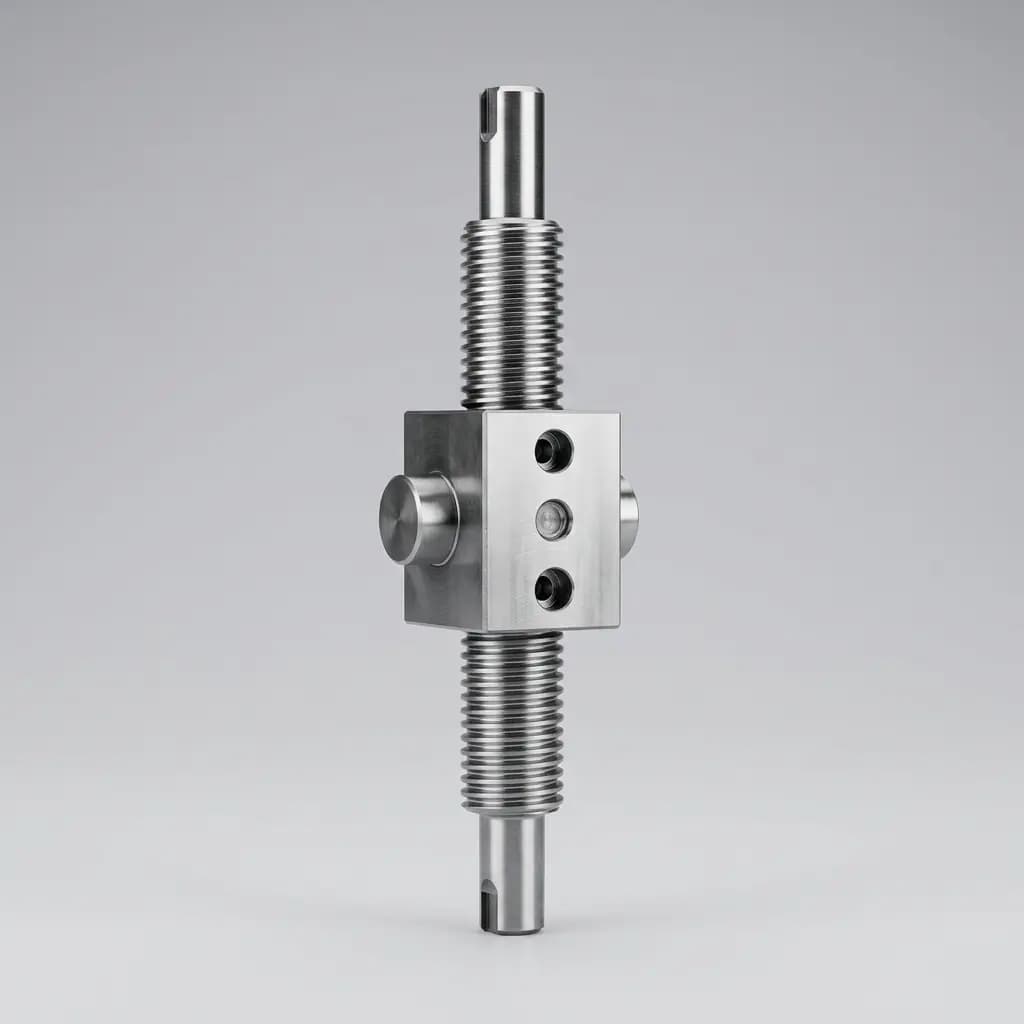
CNC Machining Tolerances Guide for Actuator Shafts: ISO 286 Fits, Cost Multipliers, and GD&T
Engineering reference for selecting ISO 286 tolerances, specifying GD&T callouts, and managing CNC cost multipliers on linear and rotary actuator shafts.
When designing a linear or rotary motion system, the actuator shaft is the critical bridge between motor torque and driven load. The lifespan of linear bearings, seals, and the overall system efficiency depends heavily on the CNC machining tolerances applied to that shaft.
Specifying "make it tight" on a drawing is a recipe for inflated quotes and delayed production. Below, we break down exact ISO fits, when to pay for custom grinding, and the real cost multipliers of your tolerance choices.
1. The Cost Multiplier of Precision
Before looking at tolerance bands, buyers must understand how precision scales cost. Moving from a standard turned finish to a precision-ground finish involves entirely different machines, secondary setups, and temperature-controlled metrology.
| IT Grade | Typical Process | Relative Cost | Common Actuator Application |
|---|---|---|---|
| IT8 / IT9 | Standard CNC Turning | 1.0x (Baseline) | Low-speed pivot pins, manual handwheel shafts |
| IT7 | Precision CNC Turning | 1.4x | Standard rotary actuator output shafts |
| IT6 | Centerless Grinding | 2.5x | Linear bearing guide shafts, high-speed rotary |
| IT5 | Cylindrical Grinding / Honing | 4.0x+ | Medical/Aerospace zero-backlash assemblies |
Never specify an IT6 or IT5 tolerance unless the mating bearing catalog explicitly demands it. Over-tolerancing is the #1 reason actuator shafts get "no-bid" responses from competent machining partners. Also keep in mind that surface treatments like anodizing will shift your final dimensions — factor that in before locking your IT grade.
2. ISO 286 Standard Fits for Actuator Shafts
For 90% of industrial actuator shafts, engineers should default to ISO 286 standard tolerance classes. Below is a reference matrix for a standard Ø20mm nominal shaft:
| ISO Class | Tolerance Band (Ø20mm) | Fit Type | Best Used For |
|---|---|---|---|
| f7 | -0.020 to -0.041 mm | Loose sliding | Thermal expansion zones, high-temp valve actuators |
| g6 | -0.007 to -0.020 mm | Close sliding | Low-speed linear actuators, manual sliding guides |
| h7 | +0.000 to -0.021 mm | Clearance / Slip | Standard ball bearings (6200/6300 series) |
| h6 | +0.000 to -0.013 mm | Precision clearance | High-speed linear bearings, precision servo couplings |
| js6 | ±0.0065 mm | Symmetric transition | Press-on timing pulleys where alignment is critical |
| k6 | +0.002 to +0.015 mm | Transition / Light press | Permanent gears, rotors, or hard-fixed pulleys |
| m6 | +0.008 to +0.021 mm | Light interference | Encoder wheels, flywheel masses requiring heat shrink |
| p6 | +0.022 to +0.035 mm | Heavy press | Permanent press-fit couplings, never-removed components |
Bearing Manufacturer Cross-Reference
Bearing vendors publish recommended shaft fits in their catalogs. We pulled together a cross-reference for the bearing families we see most often in actuator assemblies:
| Bearing Type | Recommended Shaft Fit | Source |
|---|---|---|
| Deep groove ball (62xx, 63xx) | h6 for normal loads; k6 for heavy vibration | SKF / NSK General Catalog |
| Angular contact ball (72xx) | js6 for precision; k6 for high axial loads | NSK Precision Series |
| Linear ball bearing (LM, LME) | h7 on guide shaft; H7 on housing bore | THK / HIWIN |
| Needle roller (HK series) | h5 to h6 | INA/FAG |
| Tapered roller (320xx) | k6 minimum for rotating inner ring | Timken Engineering Manual |
3. Beyond Diameter: GD&T for Actuator Shafts
A shaft can have a perfect Ø20.000mm diameter and still destroy a system if it is bowed, eccentric, or out of round. These geometric errors are caught during First Article Inspection (FAI) — but only if you specify them on the drawing.
GD&T Specification Reference
| GD&T Symbol | Callout Example | Failure Mode if Missing |
|---|---|---|
| Runout (TIR) | ⌀ 0.010 mm to Datum A-B | Harmonic vibration (whirling) above 3,000 RPM. Shattered ceramic bearings. Lip seal leakage within hours. |
| Straightness | 0.05 mm / 1000 mm | Linear actuator rod binds in guide blocks. Uneven wear on slider pads. |
| Concentricity | ⌀ 0.020 mm to Datum A | Stepped shaft runs eccentric, causing cyclic motor overload and premature bearing fatigue. |
| Cylindricity | 0.008 mm | Shaft is slightly "oval" after grinding. Bearing inner race does not seat uniformly, causing hot spots. |
| Surface Finish | Ra 0.4 μm (seal journal) | Lip seal abrades and leaks within 500 hours. Oil migration into motor windings. |
4. Material Hardness and Machinability
The material dictates how easily the CNC center can achieve and hold tight tolerances, and the cost implication is dramatic.
| Material | Machinability Rating | Cost vs. 1045 Steel | Achievable IT Grade | Notes |
|---|---|---|---|---|
| 1045 Carbon Steel | ★★★★★ Excellent | 1.0x (Baseline) | IT5 readily | Standard for linear shafts. Induction harden to HRC 58-62, then grind. |
| 4140 Alloy Steel | ★★★★☆ Very Good | 1.1x | IT5 readily | Higher fatigue strength. Used in high-cycle actuators (>10M cycles). |
| 304 Stainless | ★★★☆☆ Fair | 1.4x | IT6 difficult | Work-hardens rapidly. Requires rigid setups and frequent insert changes. |
| 316 Stainless | ★★☆☆☆ Poor | 1.5x | IT6 difficult | Even more prone to galling. Critical for marine and food-grade actuators. |
| 17-4PH Stainless | ★★★☆☆ Fair | 1.6x | IT6 achievable | Can be heat treated to H900 (HRC 44). Used for corrosion-resistant shafts needing hardness. |
| Ti-6Al-4V | ★☆☆☆☆ Very Poor | 3.0x+ | IT6 with specialist | Heat warps during grinding. Requires flood coolant and low feed rates. Aerospace only. |
5. Copy-Paste RFQ Specification Template
To get an accurate quote and avoid "no-bid" rejections from high-end machine shops, copy and modify this snippet into your RFQ drawing notes:
Material and Heat Treatment
Material: 1045 Carbon Steel per AISI/SAE standard. Heat Treat: Induction harden bearing surfaces (Datum A and Datum B) to HRC 58-62. Minimum effective case depth: 1.5mm per ASTM A255.
Dimensional Tolerances
Primary Bearing Diameter: Ø20 h6 (+0.000 / -0.013 mm). Thread: M14×1.5-6g, length 15mm. Overall Length: 250.0 ±0.1 mm.
GD&T Requirements
Runout (TIR): Max 0.015mm on bearing journals, relative to Datum A-B axis. Concentricity: Ø0.020mm between Datum A and Datum B. Straightness: 0.05mm / 1000mm.
Surface Finish
Bearing Journals (Datum A, B): Ra 0.4 μm max. Seal Interface: Ra 0.4 μm max. Non-critical spans: Ra 1.6 μm max.
Inspection Requirements
FAI: Full First Article Inspection per AS9102 with ballooned drawing. Instruments: Bearing diameters via CMM or calibrated micrometer. TIR via V-block and dial indicator. MTR: Raw material mill test report required with each lot.
By providing complete, math-backed tolerance data upfront, your factory partner can accurately quote the process routing (turning vs. grinding) and ensure your actuator performs as designed.
Quick-Select: What Tolerance Do I Need?
Typical spec: Ø20 h6 on bearing journals, k6 on gear press-fit. GD&T: TIR 0.010mm, Ra 0.4 μm on journals. Material: 4140 alloy steel, induction hardened HRC 58-62. Why: High-speed rotation demands tight runout. Grinding is usually required.
Typical spec: Ø16 or Ø20 h7 on guide bearing span. GD&T: Straightness 0.05mm/1000mm. Cylindricity 0.010mm. Material: 1045 carbon steel, hard chrome plated. Why: Linear bearings are forgiving on diameter (h7 is fine) but very sensitive to straightness. A bowed rod will bind under load.
Typical spec: Ø12 f7 to allow thermal sliding in the bushing. GD&T: Concentricity 0.030mm to flange datum. Material: 316 stainless steel, passivated per ASTM A967. Why: Valve stems operate at wide temperature swings. The loose f7 fit prevents seizure as the stem expands. See our surface finishes guide for passivation details.
Frequently Asked Questions
Author

Categories
More Posts
2026 CNC Actuator Tariffs: HS Codes & Sourcing Strategy
Actuator Machining guide to 2026 Section 232/301 tariff exposure, HS code checks, and sourcing actions for imported CNC actuator parts. Use it before RFQ.
AS9100 to IA9100 Transition (2026): What Aerospace Actuator Buyers Need to Know
AS9100 is moving toward IA9100 after ISO 9001:2026. Use this aerospace actuator machining checklist to audit cyber, MSA, traceability, and APQP supplier risk.
Dimensional Inspection for OEM Actuator Parts: CMM, Profilometers, and First Article Approval
A buyer's guide to First Article Inspection (FAI), CMM measurements, surface roughness (Ra/Rz), and material traceability for outsourced actuator components.