LogoActuator Machining
Start inquiry
LogoActuator Machining
WhatsApp
LogoActuator Machining

China-based actuator component machining supplier supporting OEM customization, inspection planning, and global delivery.

Inquiry Email

[email protected]

Email app

Include drawings, material, finish, tolerances, quantity, and delivery location.

Instant Chat

+86 188 5797 1991

Chat on WhatsApp

Direct response from our engineering team.

Products
  • Actuator Housings
  • Precision Shafts & Rods
  • Custom CNC Assemblies
Solutions
  • Robotics Components
  • Automation Equipment
  • Valve & Fluid Control
  • Aerospace & Defense
OEM Capabilities
  • Drawing Review & DFM
  • Prototype to Batch
Resources
  • Blog
  • CNC Capabilities
  • Materials & Finishes
  • Quality & Inspection
  • About
  • Contact / RFQ
  • Privacy Policy
  • Cookie Policy
  • Terms of Service
© 2026 Actuator Machining. All Rights Reserved.|Backed by Linkup Ai Co., Ltd. Manufacturing delivered by the Advanced Manufacturing Division of Linkup Precision.|Legal entity: Linkup Ai Co., Ltd.

1045 Precision Shaft Guide & Calculator

Calculate deflection limits for 1045 Turned, Ground, and Polished (TGP) carbon steel shafts and explore its machinability vs 4140 alloy steel.

Send shaft drawingOpen calculator
1045 Shaft Mechanics Simulator
Compare deflection, weight, and relative cost for 1045 TGP against other common alloys.
1.500"
24"
100 lbs

Live Results

Max Center Deflection
0.00390 inches
Stiff Setup
Estimated Weight
12.03 lbs
Relative Material Cost
$54.12 est.
Factor: 1x
Interpretation

The shaft passes this simple stiffness screen, but bearing fits, runout, hardness, and corrosion protection still need drawing review.

Boundary notes
  • L/D ratio is 16.0:1; plan steady-rest support, grinding support, or a larger diameter.
Next action

Send the drawing for DFM review before releasing the RFQ.

Start RFQ review

Engineering Note

1045 steel provides excellent strength-to-cost ratio. If your deflection exceeds limits, consider increasing the diameter rather than switching to 4140, as all steels share roughly the same Young's Modulus (~205 GPa). Upgrading material improves yield strength, not stiffness.

Executive Summary: Why 1045?

Cost-Efficiency

Lacking expensive alloying elements like Chromium and Molybdenum, 1045 avoids alloy surcharges. Use it as the baseline material when loads are moderate, then validate supplier-specific 4140 or stainless premiums during RFQ instead of assuming a universal savings percentage.

High Machinability

Rated at ~64% of B1112 (free-machining standard), it turns and threads much easier than hardened alloys, significantly reducing tool wear and cycle times for large-batch OEM production.

Stiffness is Universal

At 205 GPa, 1045 is just as stiff as expensive alloys. Upgrading to 4140 stops yielding, not bending.

Technical Specifications & Tolerances

PropertyTypical ValueNotes
Tensile Strength570 - 700 MPa (83 - 100 ksi)Varies slightly with processing
Yield Strength310 - 530 MPa (45 - 77 ksi)Point of permanent deformation
Hardness (Typical TGP)HB 163 - 223Induction case hardens to HRC 55+ (0.8 - 2.5mm depth)
Standard ToleranceISO h6 / h7Optimal for linear ball bearings
Surface FinishRa 0.2 - 0.4 μmPolished after centerless grinding

Chemical Composition (ASTM A29/A108)

Carbon (C)Manganese (Mn)Phosphorus (P) MaxSulfur (S) MaxIron (Fe)
0.42 - 0.50%0.60 - 0.90%0.040%0.050%Balance (~98.5%)

Data Sources & Verification: Mechanical properties and chemical compositions are based on ASTM A108 (Cold-Finished Carbon Steel) and ASTM A29/A29M standards. Public standards do not guarantee a specific mill condition; final acceptance still depends on the MTR, drawing, heat-treatment certificate, and inspection plan. Data last reviewed: June 25, 2026.

Ground precision shaft with controlled bearing surfaces

Ground journal control

Stepped precision shaft for motion-control assembly

Stepped shaft machining

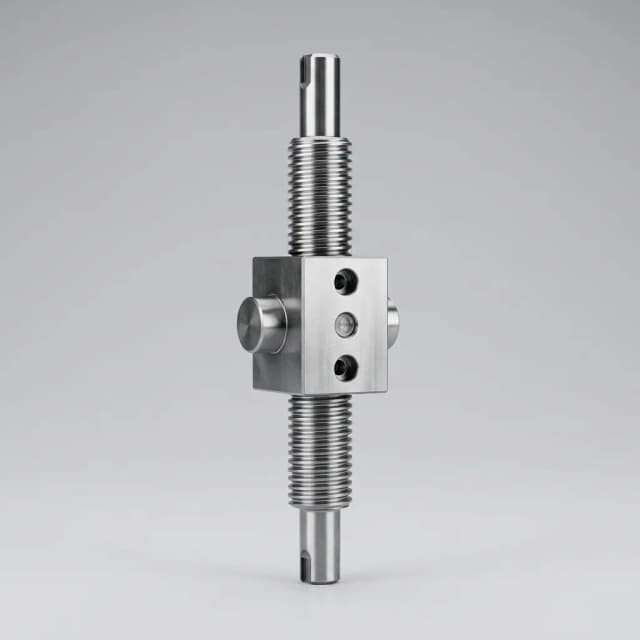
Custom precision shaft with keyway and thread features

Keyway and thread features

ASTM A108/A108M-24 cold-finished bar scopeCurrent-publication listing for cold-finished carbon and alloy steel bars used as shafting or machined components.ASTM A29/A29M-23 general steel bar requirementsGeneral requirements and chemical-analysis framework for carbon and alloy steel bars.SKF bearing-seat surface texture guidanceBearing-seat finish should be considered with dimensional and geometrical tolerances, not as a standalone spec.SKF bearing interface tolerance guidanceBearing seats should support the bearing circumference and be held to adequate dimensional and geometrical tolerances.

Corrosion Warning

1045 Carbon Steel has poor corrosion resistance. If used in exposed environments, it must be hard-chrome plated, black oxided, or regularly oiled. For washdown environments, upgrade to 304/316 Stainless.

1045 vs. Alternatives

1045 vs. 4140 Chromoly

  • Strength: 4140 Q&T (Quenched and Tempered) has a yield strength around 655 MPa, more than double base 1045.
  • Stiffness: Identical (205 GPa). Both deflect the exact same amount under an identical load. Upgrading to 4140 only stops yielding (bending permanently), not elastic deflection.
  • Cost & Machining: 1045 is the quoting baseline for this page. Compare alloy premiums, heat-treatment cost, and cycle time with current supplier quotes; heat-treated 4140 usually increases tooling and inspection burden.
  • Verdict: Use 1045 unless the shaft is failing by bending permanently or twisting under extreme torque.

1045 vs. 304 Stainless

  • Corrosion: 304 is highly resistant; 1045 rusts easily without plating or oil.
  • Strength: 1045 TGP (Yield ~310+ MPa) is significantly stronger than standard annealed 304 Stainless (Yield ~205 MPa).
  • Cost: Stainless usually carries a material premium and can add machining difficulty. Confirm the premium by quote date, diameter, and purchased condition.
  • Verdict: Use 1045 for indoor/dry applications (can be hard-chrome plated for wear/rust). Upgrade to 304 only when corrosion is a guaranteed threat.

Decision Boundaries and RFQ Risks

Use the calculator as a screening tool. The table below explains when the page output is reliable enough for RFQ preparation and when a drawing review should override the quick estimate.

DecisionUse 1045 WhenEscalate or Change Material WhenNext Action
StiffnessDeflection is acceptable after checking span, support, and diameter.Deflection fails; changing from 1045 to 4140 alone will not solve elastic bending.Increase diameter, shorten span, or add support.
WearOnly journal surfaces need wear resistance and can be induction hardened then ground.The whole shaft needs through-hardness or shock resistance.Quote hardening targets, case depth, and grind allowance.
EnvironmentThe shaft operates indoors with oil, plating, or planned corrosion protection.Washdown, salt, condensation, or exposed outdoor service is expected.Compare coating stack-up against 304/316 stainless.

Need a drawing-specific 1045 shaft check?

Send diameter stack, bearing fits, runout, heat treatment, coating, and volume so engineering can confirm the route.

Request RFQ review

Frequently Asked Questions

Can 1045 be induction hardened?

Yes, 1045 has enough carbon for localized induction hardening on wear journals. Treat HRC and effective case depth as quote-controlled targets that must be verified after heat treatment.

Is 1045 weldable?

1045 can be welded, but the medium carbon content makes it crack-sensitive without preheat, controlled filler selection, and post-weld stress relief. It is not as forgiving as low-carbon 1018.

What does TGP mean?

TGP means turned, ground, and polished. For shafting, it signals a route intended to improve diameter control, surface finish, and bearing-interface consistency.

When should I choose 4140 instead of 1045?

Choose 4140 when torsional shock, reversing fatigue, or through-hardening requirements drive the risk. Do not choose it only to reduce elastic deflection, because steel modulus is broadly similar.

What RFQ details matter most for a 1045 precision shaft?

Include material condition, diameter and length, bearing-fit tolerances, runout, straightness, finish requirements, heat treatment zones, coating, annual volume, and inspection method.

Can 1045 be used outdoors?

Only with a corrosion plan. Bare 1045 rusts readily, so outdoor or washdown applications usually need chrome, nickel, black oxide plus oil, or a stainless alternative.

Need Custom Machined 1045 Shafts?

Send drawings for precision turning, centerless grinding, and milling review. Include material condition, tolerance, finish, hardness, and annual volume so engineering can validate the route before quoting.

Inquiry Email

[email protected]

Email app

Include drawings, material, finish, tolerances, quantity, and delivery location.

Instant Chat

+86 188 5797 1991

Chat on WhatsApp

Direct response from our engineering team.